Green solutions rely on non-renewable rare earth elements and critical metals. While they appear to cut emissions, they often shift pollution upstream and create other serious environmental harms, worsened by industry leaders protecting monopolistic control.
The push for a net-zero global economy by 2050 is an ambitious challenge, one that fundamentally tests the relationship between human development and our planet. The recent COP30 has been significant as the global temperature increase has now remained above 1.5ºC for over a year, challenging the goals set in the 2015 Paris Agreement. The “COP of Truth”, according to Brazil’s President, Luis Inácio Lula da Silva, exemplified the acute geopolitical friction and systemic ambiguity surrounding this matter; a lack of presence from the US along with China’s seemingly calculated apathy set the stage for Europe to push for divestment from coal, oil, and gas only to be shut down by Saudi Arabia who warned that targeting its industries would collapse negotiations (Abnet et al., 2025). Our reliance on hydrocarbons such as coal, to fuel rapid globalisation since the Industrial Revolution in the 18th century, has been heavily criticised due to the significant quantities of greenhouse gases that are released during combustion - primarily Carbon Dioxide (CO2) and Methane (CH4). This has led to the formation of numerous activist groups such as Just Stop Oil, who aim to raise awareness to the consequences of our myopic actions in attempts to prevent further fossil fuel projects.
Demand Pressures on Renewable Technologies
‘Green’, renewable solutions are widely regarded as the necessary alternative to reduce pollution, resource depletion, and fight anthropogenic climate change. Widespread adoption of technologies like solar photovoltaics, wind turbines, hydroelectric plants, electric vehicles (EV’s), etc. is promoted in pursuit of sustainable development - meeting today’s needs, without compromising the ability for future generations to do the same. As the global population continues to boom, projected to reach just shy of 10 billion by 2050, the Malthusian view suggests our planet will be unable to sustain the corresponding demand increase for resources. Though in theory, technological advancements should lead to greater efficiencies, Goldman Sachs Research forecasts AI to drive up energy demand in Europe by 40-50% over the next decade which will further compound the strain on resources.
This field has occupied the spotlight for many years now and persistent lobbying has led to the creation of numerous government schemes aimed at fostering the industry, e.g. renewable energy subsidies (estimated £25.8 Billion per year in the UK alone), carbon permits and tax incentives; vast amounts of research have studied the merits to employing these technologies. The drawbacks of green technologies receive far less exposure: there is a particular lack of awareness regarding the energy-intensive manufacturing processes and the pivotal role played by critical raw materials. In order to comprehensively evaluate the sustainability of these products, it is important to examine all phases of their life cycle.
Reliability and Storage
Reliability is the primary challenge arising from an energy supply dependent on nature, as weather is an inherently unpredictable and inconsistent variable. Wind turbines, for example, obviously require sufficient wind velocities to turn and generate electricity, however the fact that they also cannot handle strong winds, needing to be turned off during storm periods, is often overlooked: operating wind speed range for most popular models is limited to between 3 and 25 meters per second. Solar farms face similar challenges due to unpredictable cloud cover as well as the daily cycle on account of the sun. During periods of insufficient energy generation from renewable sources, fossil fuels will typically be used to substitute and meet demand necessitating the frequent onramp and offramp of power plants, resulting in considerable waste. The Iberian Peninsula, a region with significant reliance on solar energy (around 60%), is a notable victim of renewable energy’s volatility in production: large fluctuations experienced 28 April 2025 caused Spain’s power system to collapse, leading to blackouts across the region, significant disruptions to critical infrastructure and even deaths.
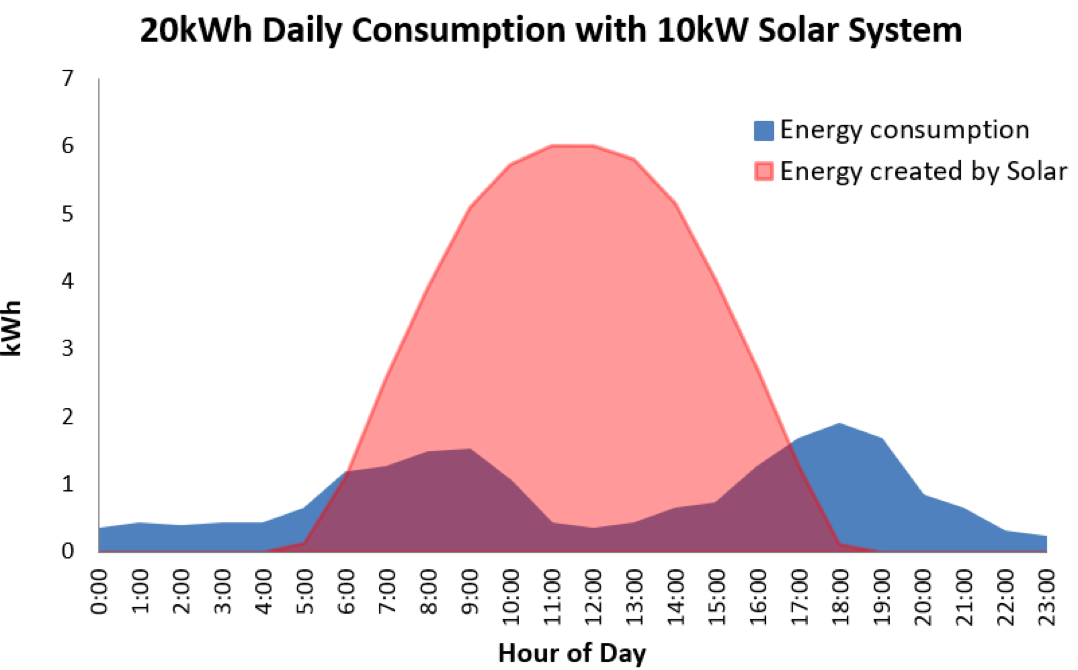
In theory, the solution to this variability in energy production lies in storage which would ideally enable excesses to be saved for times of insufficient supply. However, as things stand, battery technology currently cannot facilitate this at the industrial scale required for commercial use: they are incredibly expensive, more so than the cost of energy that can be stored, and they cannot retain meaningful quantities of energy for long enough. Existing operating time frames span from seconds to a few hours. This is useful to alleviate intraday supply/ demand misalignment, however, inter-day storage is not yet possible let alone a seasonal scale. Figure 1 shows the energy misalignment between solar production and an average UK household’s consumption on a daily level; we can see that peak production tends to occur around the middle of the day whilst peak consumption is typically in the evening. Similarly, at a seasonal level, production is lowest during the winter when there is highest demand for energy. Although research and development is exploring options such as gravity storage, pumped hydro and compressed air, which can potentially work over longer time periods, they are currently not viable at an industrial level to facilitate the complete transition to green solutions.
Figure 1. Energy produced by a 10kW solar farm overlayed on the UK daily average household energy consumption.
Research comparing renewable sources to hydrocarbons tends to focus on the emissions incurred whilst actively producing energy, however the production process gives rise to significant amounts of pollution and other environmental ramifications. This is especially relevant considering the average longevity of wind and solar farms is roughly 20 years and 30 years respectively. Large scale infrastructure projects are bound to disrupt and alter local environments, negatively affecting complex yet fragile ecosystems (chemical leaching, electro-magnetic charges, habitat destruction); research by Galparsoro et al.into the ecological effects of offshore wind farms reveals a general lack of understanding in this area. Another consideration is the opportunity cost for occupying land, which could otherwise be used for much needed agriculture and/or housing for example.
Critical Materials
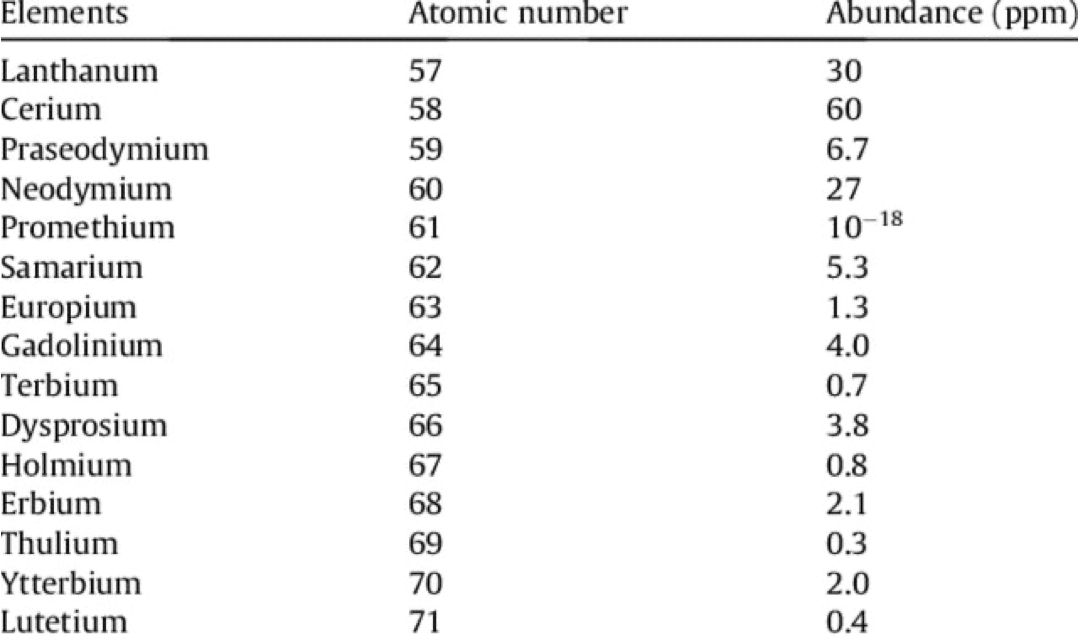
Technology as a whole is predicated on critical metals such as copper, lithium, nickel, cobalt, etc. and Rare Earth Elements (REE); these flagship green solutions are no exception. From energy efficient lightbulbs to hydroelectric dams, from batteries to electric engines, these elements are hidden throughout our everyday lives and central to the evolution of technology. To the naked eye REEs are inconspicuous, they do not display the lustre of gold or the brilliance of diamonds, however they possess unique chemical and physical properties which open amazing possibilities allowing technology to become smaller, faster and stronger, arguably making them more precious than oil. REEs refer to the 15 elements within the Lanthanide series, atomic numbers 58-71, (the upper row of the bottom bar on the periodic table) plus Scandium (21) and Yttrium (39). Though technically no less abundant than other elements (Figure 2), they are considered rare due to the difficulty obtaining industrially useful quantities of the isolated element. Typically existing in very low concentrations, widely dispersed within the surrounding rock, there are few places where extraction is economically viable. The mining procedures execute in much the same way as for any mined resource, however processing REEs is much more complex and incredibly energy intensive. A characteristic feature of REE’s is the tendency to form and stick together; chemically isolating individual elements along with purification requires strong solvents, specifically sulphuric, nitric and hydrochloric acids. On top of this, REEs are often naturally bound to radioactive elements, such as Uranium and Thorium, that interact with chemicals to create toxic, radioactive effluents.
Figure 2. Abundance of the Rare Earth Elements within the Earth’s Crust.
Kumari, Archana & Panda, Rekha & Jha, Manis & Kumar, Jitendra & Lee, Jin. (2015). Process development to recover rare earth metals from monazite mineral: A review. Minerals Engineering. 79. 10.1016/j.mineng.2015.05.003.
These complicated procedures are prone to accidents: throughout the 1990s, Molycorp’s Mountain Pass Mine California leaked over 1 million gallons of radioactive and chemically contaminated toxic waste, much of which ended up in the Mojave National Preserve causing environmental damages and contaminating the drinking water supply (The Grand Canyon Trust, 2024). These consequences are not easily absorbed by local ecosystems and have lasting effects which challenge the overall sustainability of this industry.
Each of the REEs can be bonded with metals to form alloys with specific enhancements. Supermagnets, for example, utilise neodymium to dramatically increase strength along with dysprosium and terbium to resist demagnetisation creating permanent magnets. These supermagnets in turn have myriad uses, particularly within the energy transition narrative. The average 5MW wind turbine contains 800kg of neodymium and 200kg of dysprosium with newer models requiring up to 4 tonnes. A similar reliance is demonstrated with solar panels and hybrid/electric vehicles – a Toyota Prius requires 25lbs of rare earths.
Geopolitical Perspective
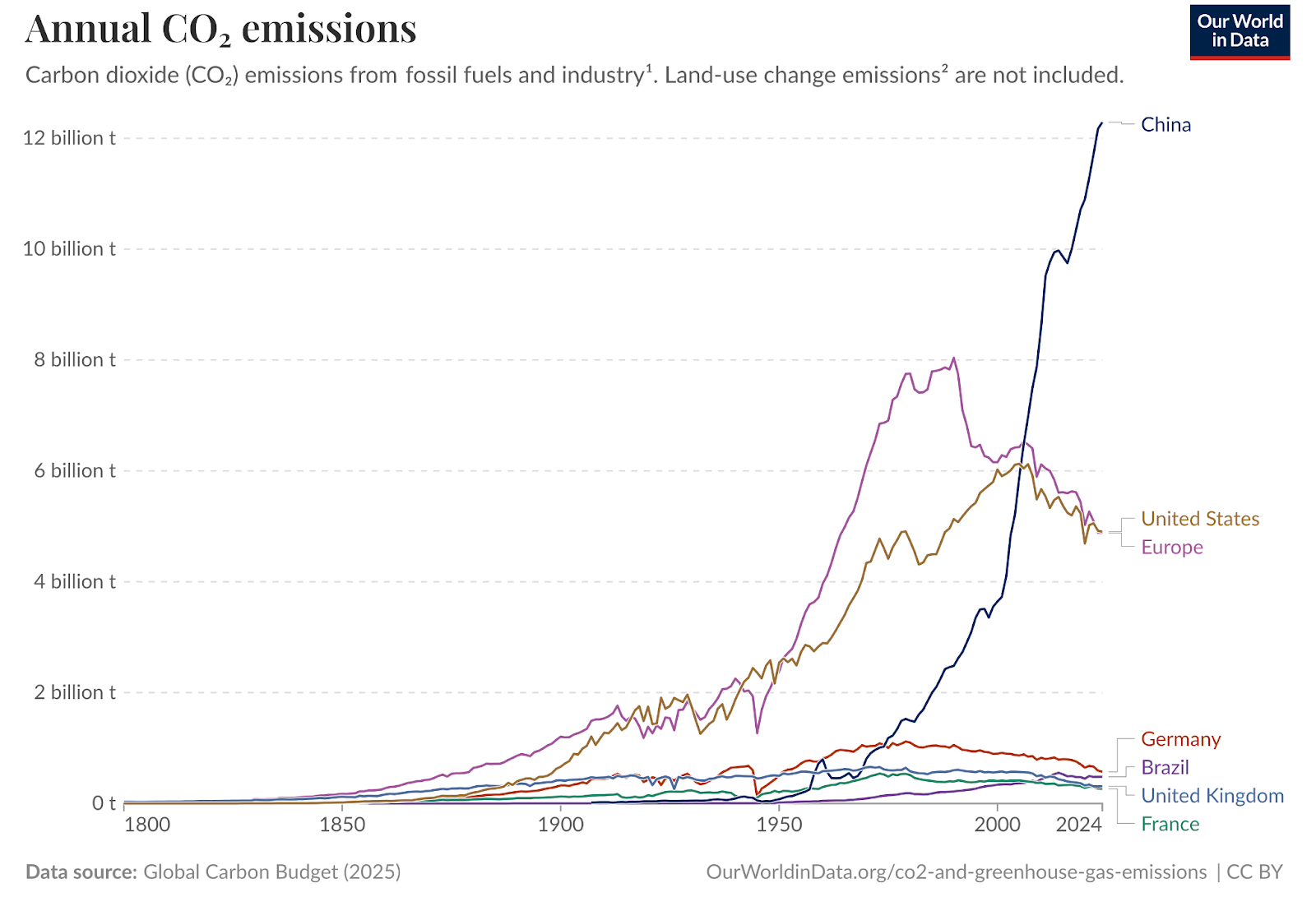
These properties are of keen interest to militaries, which leads to controversy and extraordinary geopolitical tension regarding supply security. As Rare Earths mining became more prevalent over the past 2 decades, western nations in particular the US and Australia which previously pioneered this industry, began implementing more stringent environmental regulations to prevent repeats of the Mountain Pass Mine incident; China seized this opportunity to take the lead, exploiting its cheap labour force, lack of safety regulation and willingness to disregard environmental harm (Figure 3). As Mountain Pass, the largest REE mine at the time, was forced to shut in 1998, China’s Baotou swiftly became the “Rare Earths Capital of the Word” (Epstein et al., 2011).
Figure 3. Comparison of countries by emissions levels (including the whole of Europe for reference).
China, a name now synonymous with Rare Earths, currently operates a clear global monopoly in both the extraction and processing of ores, >70% and >90% respectively according to Andrews-Speed et al.. This dominance is the result of deliberate, strategic action set into place by Deng Xiaoping, who remarked that “the Middle East has oil, China has Rare Earths”. This dependence has been actively weaponised as a political tool through the implementation of export controls, demonstrated in 2010 when China curtailed supply to Japan following an unrelated maritime dispute. Subsequently, this remains one of the key bargaining chips used against the US, Europe and many other economies during trade negotiations. Furthermore, the price for achieving 97% of global production has been dear (Zhou et al., 2021): toxic contamination of groundwater and radioactive dust particles carried in wind have caused animals grazing in the vicinity to die of poisoning, children to develop intellectual disorders (Wang, et al., 2007), and forced communities to relocate (Bradsher 2025). Such profound ecological and social devastation underscores the fundamental unsustainability of this industry which is commonly unaddressed in the fight against climate change.
The world is searching for alternative supplies of rare earths, the importance of this industry has been recognised, and it is becoming evident that China cannot be relied upon as the sole provider. The US government’s recent investments in REE mining companies such as MP Materials, who now own the Mountain Pass Mine, combined with threats to supply, briefly sent market into a frenzy causing scores of companies to double or even triple their market capitalisations (Critical Metal Corp’s share price increased almost 500% at its peak over through the first two week of October this year). However, this was short lived and followed by healthy parings as trade negotiations with China cooled off.
The Future of Sustainability
Environmental damage is a multifaceted issue and purely considering greenhouse gas emissions is a dangerous oversimplification. On top of carbon emissions, the use of rare earths leads to a vast array of other issues conflicting the apparent sustainability of renewable solutions. How bright is our future if we’re secretly poisoning our planet today? Tackling these complexities is difficult, for example recycling old technology presents significant challenges as there is no ‘ingredients list’, each device must be manually taken apart and examined for contents. Potentially revisiting legacy mines could prove fruitful as elements which previously were deemed economically irrelevant may still be easily accessible (Evans, 2024). Ultimately, as things stand, renewable energy solutions rely on non-renewable raw materials. The prevailing focus on downstream decarbonisation engenders a societal complacency: in reality, these attempts to protect our future merely shift emissions upstream and trade one form of pollution for another.
Ajayi, Oluseyi & Ojo, Olorunfemi & Vasel, Ahmed. (2019). On the need for the development of low wind speed turbine generator system. IOP Conference Series: Earth and Environmental Science. 331.012062.DOI: 10.1088/1755-1315/331/1/012062
Galparsoro, I., Menchaca, I., Garmendia, J.M. et al. Reviewing the ecological impacts of offshore wind farms. npj Ocean Sustain 1, 1 (2022). https://doi.org/10.1038/s44183-022-00003-5
Le Zhou, Jianping Ge, Estimating the environmental cost of mixed rare earth production with willingness to pay: A case study in Baotou, China, The Extractive Industries and Society, Volume 8, Issue 1, 2021, Pages 340-354, ISSN 2214-790X, https://doi.org/10.1016/j.exis.2020.11.010