The Protectors of Petrol
A look at Porsche’s new six-stroke engine patent and what it could imply for the future of the combustion engine
– 6 min read
A look at Porsche’s new six-stroke engine patent and what it could imply for the future of the combustion engine
By Matthew Hoult
The Protectors of Petrol
In a world where over 17.1 million(1) electric vehicles (EVs) joined the roads last year, and the statistics say that 35% more EVs were bought in Q1 2025 compared to the previous period in 2024, is the fate of the internal combustion engine looking ominous? Porsche took a look at the same statistics and disagreed. In late 2024, the German manufacturer patented a novel petrol engine design for an internal combustion engine, with the ‘novel’ aspect being that this engine runs on a six-stroke thermodynamic cycle, as opposed to the traditional four (or two) stroke engines found in most combustion vehicles on the road today.
The patent itself, officially filed in the U.S. Patents Office in February 2024 by Porsche (in collaboration with Cluj-Napoca University, Romania(2)) laid out the basic mechanical framework for a six-stroke engine. Interestingly, they actually describe it as a ‘2 x 3-stroke’ engine, but we will call it the six-stroke engine for simplicity. The patent was approved in September 2024, just under seven months later.
To understand what the six-stroke cycle involves and how it could spark innovations in internal combustion, we need a comparison between the status-quo four-stroke cycle, and the still popular two-stroke cycle. From here we can identify where this novel approach could have potential advantages in terms of efficiency and emissions, by combining the best features of both cycles.
The Four-Stroke Engine
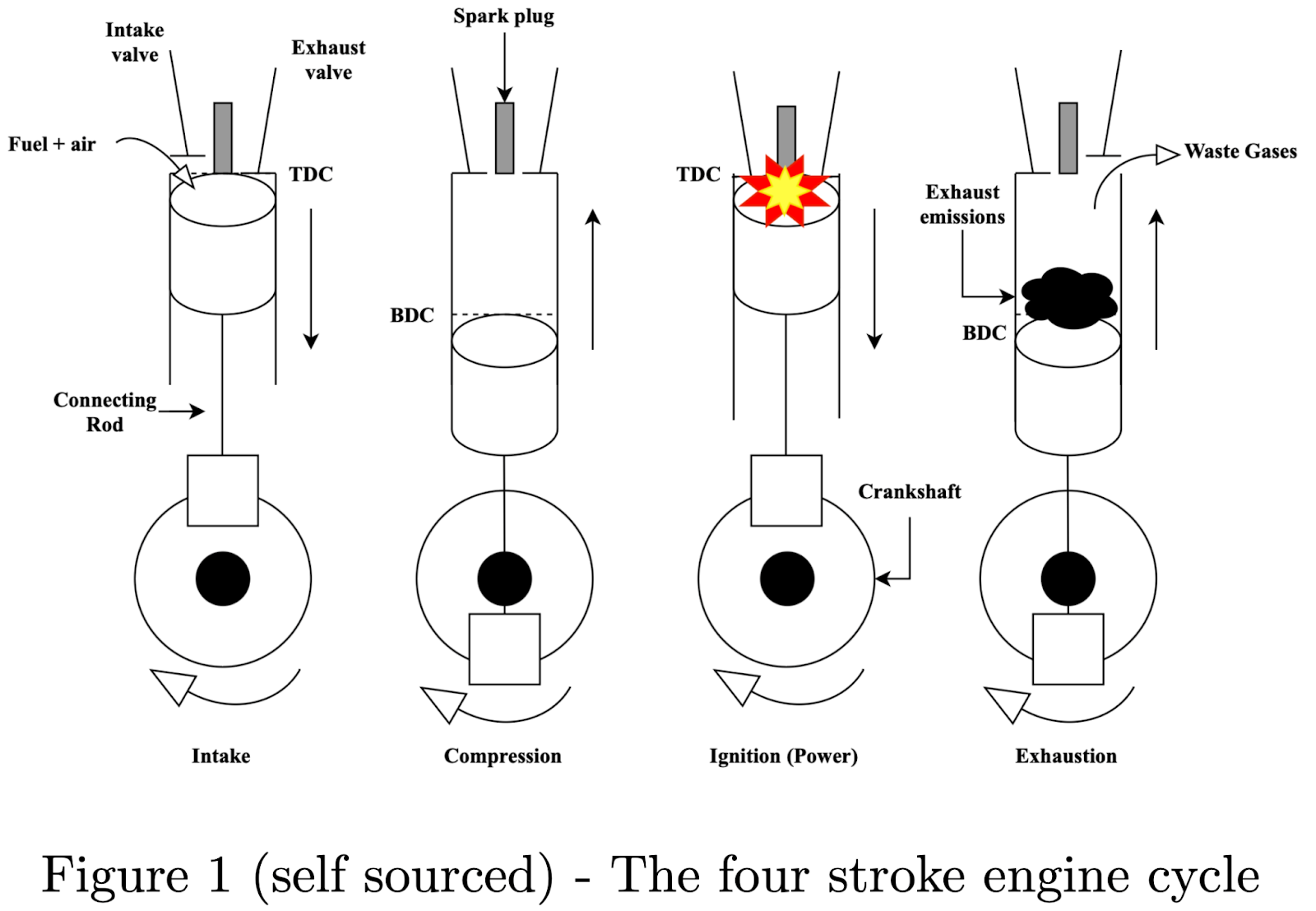
The four-stroke thermodynamic cycle, developed by German engineer Dr. Nikolaus Otto in 1876(3), characterises an ideal reciprocating thermodynamic cycle in four processes. These four strokes in order are: Intake, compression, ignition and exhaustion. These give this cycle its name. For simplicity of comparison we will look at this ideal theoretical cycle, but it is worth noting that there are two more interim processes in this combustion engine. Modern petrol engines can achieve around 25 - 30%(4) thermal efficiency, with Formula 1 turbo hybrid engines with estimates of up to an impressive 53%. A simple schematic of the four-stroke cycle is shown in figure 1.
The Two-Stroke Engine
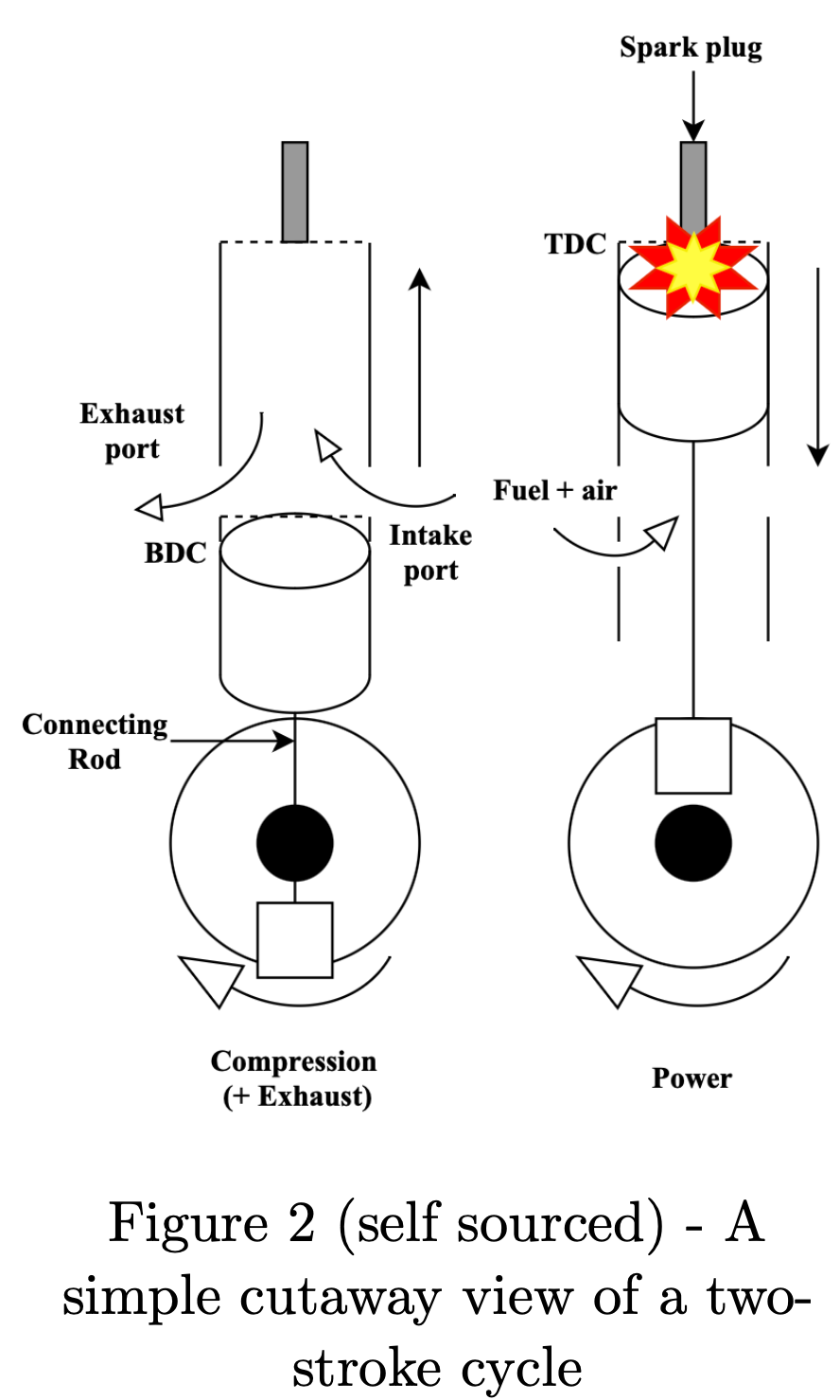
The two-stroke cycle, first patented by Scotland’s Dugald Clerk in 1881(5), uses a slightly less thermodynamically efficient cycle but with the added benefit of less mass per cylinder, and overall lack of complex mechanical valvetrain systems. In a two-stroke engine, the intake/exhaust ports are effectively governed by the piston itself. However, the main drawback is the incurred efficiency losses. These losses stem from not using up all of the available fuel for combustion, as well as drawing in some oil that is used in the combustion process. This releases more hydrocarbons than a four-stroke engine, increasing emissions and also fuel wastage. Some unburnt fuel is ejected from the cylinder as the intake port is open at the same time as the exhaust port. These overall efficiency losses are why the four-stroke Otto cycle is more widely used in gasoline car engines today, with two-stroke engines being reserved for situations where power/weight is critical (chainsaws, mopeds etc…). Figure 2 shows a simple schematic of the two-stroke engine:
The Six-Stroke Engine
Taking a closer look at the six-stroke engine, we can see some distinct features of both four and two stroke engines. The patented six-stroke engine shares the first three strokes with the four-stroke cycle. This is followed by a ‘scavenging’ and reignition of exhaust gases (two-stroke derived), which make up the fourth and fifth stroke, with the final stroke of the six being shared with the final stroke of the four-stroke cycle. Combining, the six-stroke cycle looks like this:
Intake > Compression > Ignition (Power) > Scavenging (compression) > (re)ignition (Power) > Exhaust
Four-stroke derived - Two-stroke derived
So by combining the unique features of each cycle, we arrive at the six-stroke engine. The (not so) simple schematic can be found in figure 3:
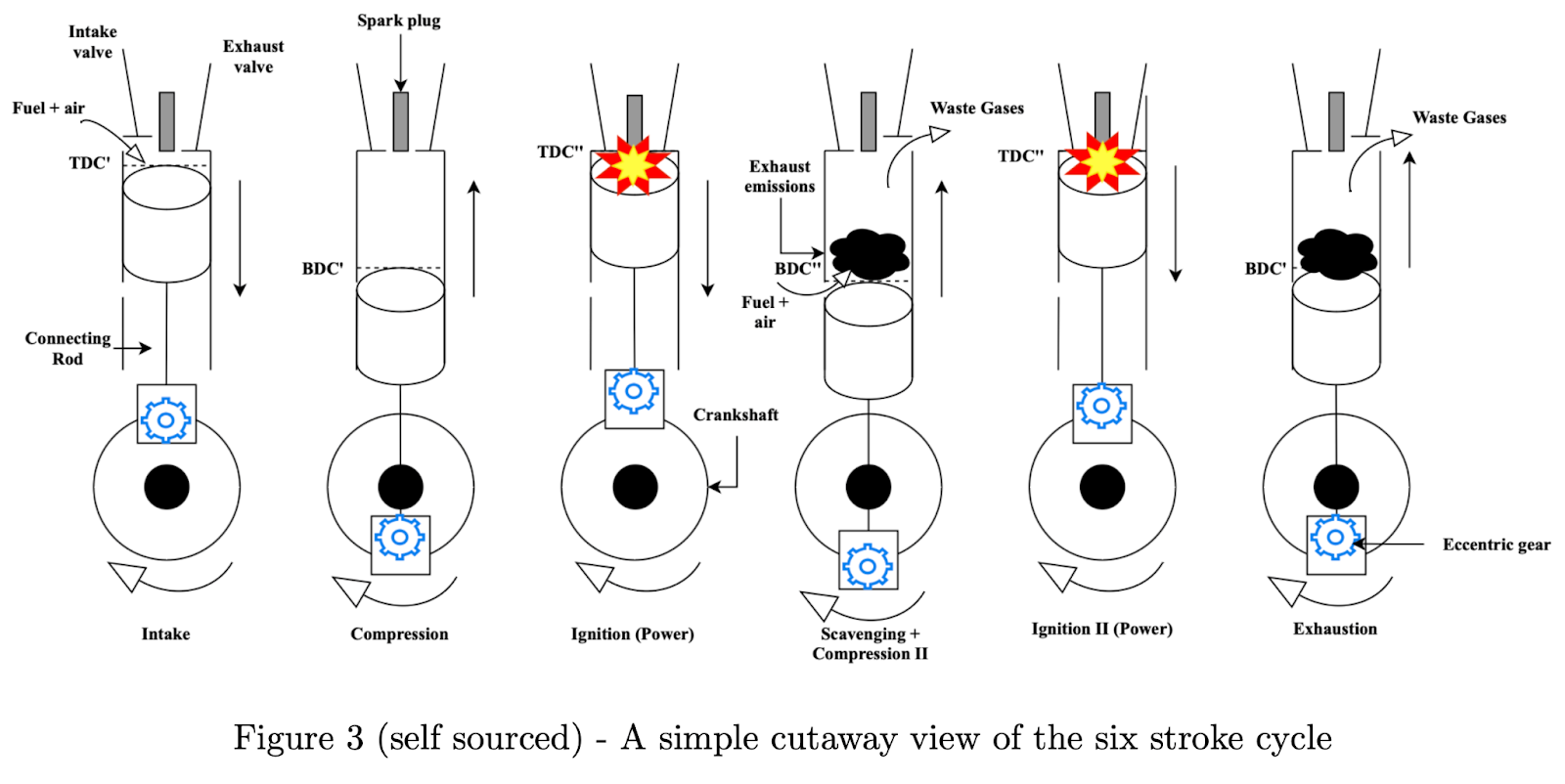
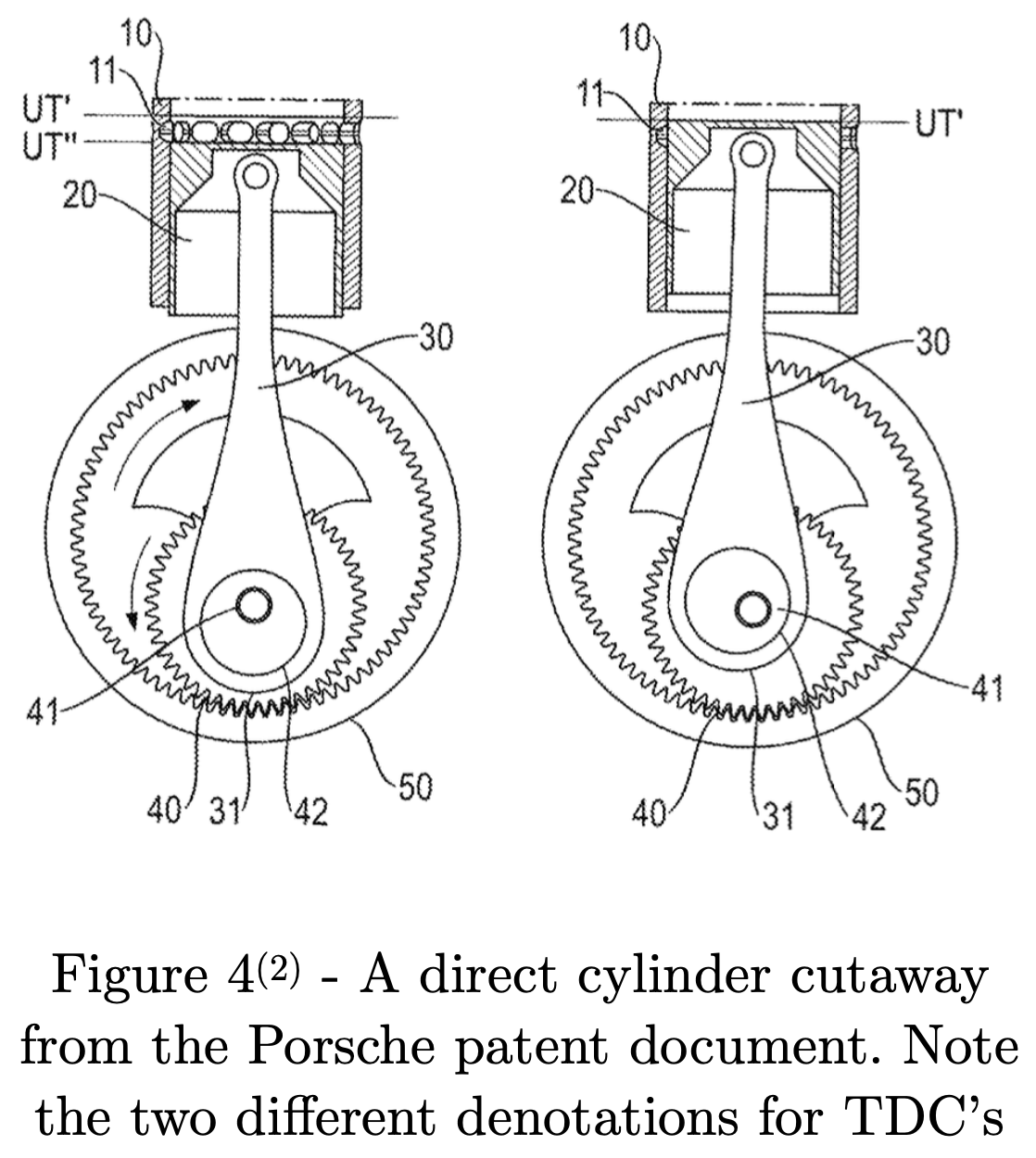
One unique feature to notice straight away is the addition of an eccentric gear orbiting the crankshaft. In order to achieve the six-strokes, the patent calls for a small planetary gear to rotate around the crankshaft to give the piston two different top-dead centres (TDC’s) and bottom-dead centres (BDC’s). These are illustrated in figure 3 with the denotations of ’ and ’’ to mark the first and second positions respectively (e.g BDC” = second bottom-dead centre). The difference in these BDC’s allow the piston on the fourth stroke to draw more charge air into the combustion chamber as the previous power stroke comes to an end. This extra depth (only achievable through the use of the eccentric gear) allows valves to be opened akin to the two-stroke engine intake which causes fresh air and fuel to be circulated inside the cylinder. This fresh air and fuel mixture are then compressed immediately after, and then the fifth stroke makes the second power stroke of the cycle. Figure 4(2) shows the eccentric gear setup straight from the patent paper.
The addition of the second power stroke is uniquely fascinating. Table 1 shows a quick breakdown of the key characteristics of the 3 engine types.
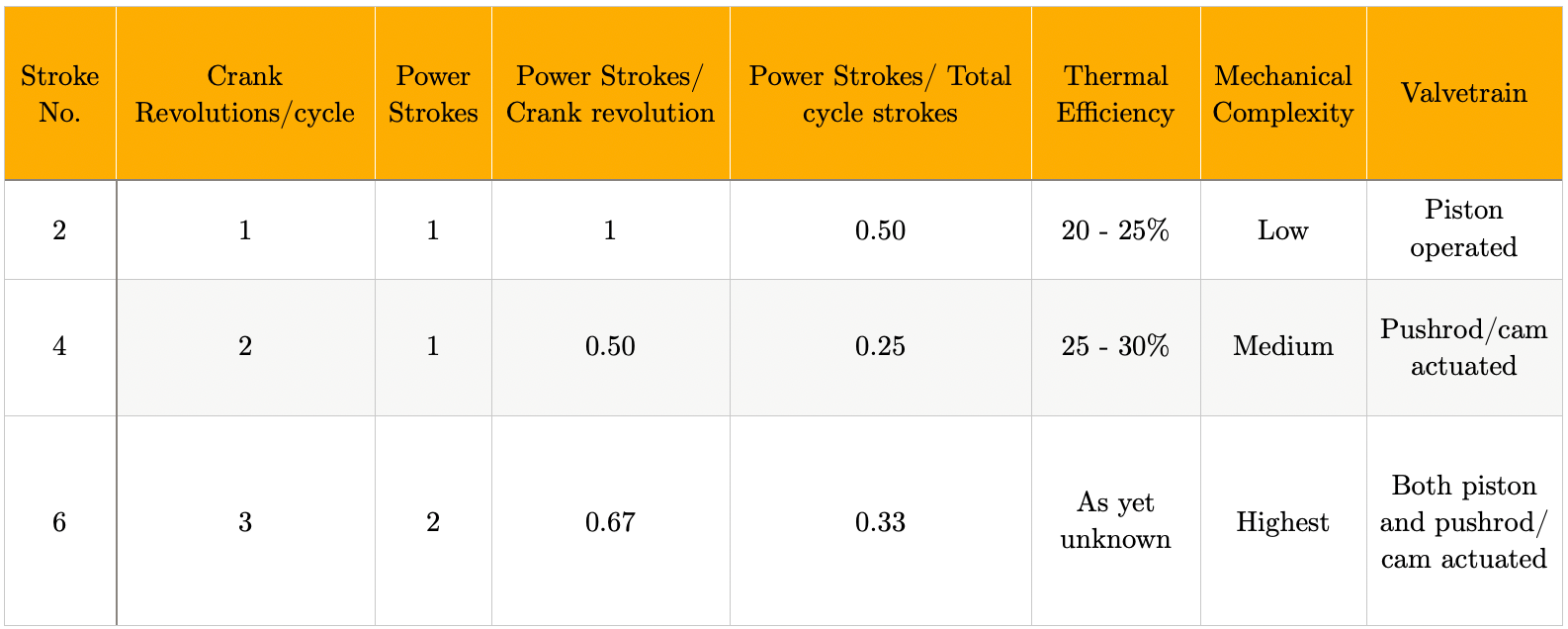
The takeaway from table 1 is that, over the four-stroke engine, the six-stroke engine has 33% more power strokes per thermodynamic cycle, as well as 33% more power strokes per crank revolution. This means it will deliver more useful work per crank rotation. Given that high compression ratios are critical to thermodynamic efficiency in internal combustion engines, the use of a secondary BDC and TDC in the six-stroke engine is conceptually very promising. What remains to be seen of course, is actual test data of this mechanical concept. But on paper, the six-stroke engine appears to have an edge over the four-stroke in terms of power delivery frequency, and the edge over the two-stroke in terms of combustion efficiency, since much less oil is intentionally burned in the process. Overall, this six-stroke engine appears to have the power to reduce emissions and drive up combustion efficiency over the current automotive options.
Conclusion
So in terms of application, is Porsche going to take this to the next level? We can’t be certain, since a year after the patent was published, Porsche has yet to announce whether they are actually committed to bringing this concept to the road, let alone whether they have tested or researched it further. If six-stroke engines were to be commercialised and ‘protect’ the use of petrol, they would need to go through a significant amount of testing to iron out the inherent disadvantages; including uneven firing patterns, increased moving parts, and valvetrain complexity. Having said that, we do owe Porsche credit for trying to innovate the humble internal combustion engine as to not let it die out in the age of electrification and beyond.
References
1 - Tromans, P. (2024). Electric car statistics - EV Data [Update: March ’24] | heycar. [online] heycar.co.uk. Available at: https://heycar.com/uk/news/electric-cars-statistics-and-projections.
2 - Google.com. (2024). US20240301817A1 - Method for a combustion machine with two times three strokes - Google Patents. [online] Available at: https://patents.google.com/patent/US20240301817A1/en.
3 - Bryant, L. (1966). The Silent Otto. Technology and Culture, 7(2), p.184. doi:https://doi.org/10.2307/3102082.
4 - Leach, F. Kalghatgi, G. Stone, R. Miles, P. (2020). The scope for improving the efficiency and environmental impact of internal combustion engines. Transportation Engineering. Volume 1. 100005. ISSN 2666-691X
5 - Coolspringpowermuseum.org. (2019). The Flywheel. [online] Available at: http://www.coolspringpowermuseum.org/Publications/Flywheel/Flywheel_20190102.htm