As a society we are becoming increasingly aware of our negative impact on the environment. Research into more novel energy solutions like hydrogen energy may be our gateway to a decarbonised energy sector.
Hydrogen is the most abundant element on Earth; in fact, it accounts for 75% of all matter (National Grid, 2023). But what does this mean for us? Carbon emissions caused by combustion of fossil fuels are causing accelerated climate change and a strain on natural resources. A solution: hydrogen, which is a carbon neutral and energy-dense resource. It has approximately three times the energy density of crude oil meaning that less of it is needed to meet energy demands (US Department of Energy, 2024). Presuming it is sourced sustainably, there is minimal effect on climate change. If suitable infrastructure is used to source hydrogen, we can significantly reduce demand for fossil fuels. Despite this, hydrogen is not widely used due to concerns in safety, rising costs and lack of infrastructure.
How does it work?
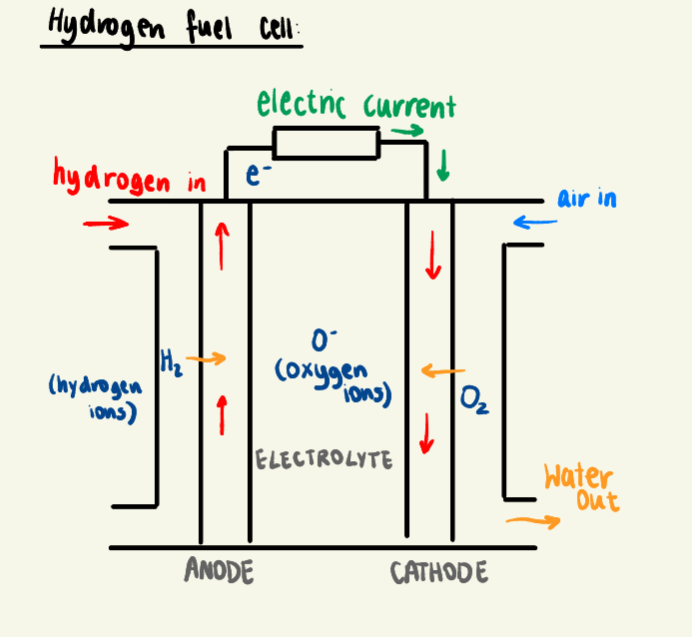
To turn pure hydrogen into a useful energy source, it requires a fuel cell to convert it into electricity, making it a secondary source of energy. Fuel cells have already been implemented in some cars, such as the commercially available Toyota Mirai. A traditional hydrogen fuel cell contains an anode (positively charged electrode), cathode (negatively charged electrode), and an electrolyte substance that conducts the charge (Manoharan et al, 2019). Hydrogen is fed into the anode component, and electrons are separated by a proton exchange membrane. Electrons are passed through an external circuit which generates electricity (US Department of Energy, 2024). Positively charged protons move towards the cathode and hydrogen atoms join with oxygen from the air to produce a clean water byproduct. Unlike diesel and petrol engines, hydrogen fuel cells produce no emissions, whilst also being more reliable than lithium-ion batteries over long journeys; hydrogen could arguably lead the future of transport.
A diagram displaying how hydrogen fuel is converted into electricity in a fuel cell by combining hydrogen with oxygen, which splits the hydrogen atoms and allows electrons to enter the external circuit.
Current extraction of hydrogen:
With research into hydrogen energy rapidly on the rise, the hydrogen economy is expected to reach 1.4% of global energy expenses and surpass a substantial $300 billion by 2030 (Gomonov et al, 2025). Currently, a large proportion of our hydrogen supply is extracted using steam reforming technology; hydrogen extracted in this way is known as blue hydrogen. This technology involves interactions between natural gas and steam at high temperatures. A synthesised gas is formed, containing hydrogen monoxide and carbon dioxide which is then cooled which allows the desired hydrogen product to separate (Sadeq et al, 2024). However, the heavy processing required and excess greenhouse gas emissions means that it defaces hydrogen’s fame as a ‘green fuel’.
Novel hydrogen extraction technologies:
Despite the overall carbon footprint of blue hydrogen being on the disappointing end, there is still room for novel technologies, such as implementing use of electrolysis or biotechnology. Green hydrogen, that is hydrogen extracted using electrolysis technology, relies on using an electric current to separate water into oxygen and the desired hydrogen product. In some ways, this technology can be thought of as a reverse system to that in a hydrogen fuel cell. An electrolyser contains an anode and cathode submerged in an electrolyte substance. Positively charged hydrogen ions are attracted to the negatively charged cathode and are collected. Because water is freely available, and the process does not release greenhouse gases, overall carbon footprint is reduced, making this a cleaner alternative to blue hydrogen.
Green hydrogen systems are also being integrated into synergy systems (US Department of Energy, 2024). The hydrogen economy can be merged with wind farms – and during periods of surplus energy generation, the excess electricity is used to power the electrolyser for hydrogen production, making this highly energy efficient. We are also transforming hydrogen extraction through the application of biotechnology. Some species of algae and cyanobacteria (a unicellular organism) produce hydrogen during the process of biophotolysis (Li et al., 2022). Similarly to photosynthesis in plants, biophotolysis is a process that uses sunlight to split water molecules into hydrogen and oxygen products, and is dependent on enzymes (Manish and Banerjee, 2008). By harvesting these micro-organisms, we could extract hydrogen that is already naturally forming in the world around us without our direct manipulation, and offer a less energy intensive alternative to hydrogen sourced through steam reforming. Hopefully, with engineering constantly taking place, we’ll soon have even more novel solutions to the struggle of extracting hydrogen fuel.
In a world predominantly powered by fossil fuels, investment into cleaner fuels such as renewables or secondary fuels such as hydrogen is indispensable. Despite hydrogen fuel cell technology not being currently widely implemented, there is widespread research into using it in vehicles as well as aviation. By decarbonising our transport sector, we could significantly reduce our emissions and hopefully achieve net-zero, and this could all be done just by investing in the increasingly popular hydrogen economy.
References:
Gomonov, K., Permana, C.T. and Handoko, C.T. (2025). The Growing Demand for Hydrogen: Current Trends, Sectoral Analysis, and Future Projections. Unconventional Resources, p.100176. doi:https://doi.org/10.1016/j.uncres.2025.100176.
Li, S., Li, F., Zhu, X., Liao, Q., Chang, J.-S. and Ho, S.-H. (2022). Biohydrogen production from microalgae for environmental sustainability. Chemosphere, 291, p.132717. doi:https://doi.org/10.1016/j.chemosphere.2021.132717.
MANISH, S. and BANERJEE, R. (2008). Comparison of biohydrogen production processes. International Journal of Hydrogen Energy, 33(1), pp.279–286. doi:https://doi.org/10.1016/j.ijhydene.2007.07.026.
Manoharan, Y., Hosseini, S.E., Butler, B., Alzhahrani, H., Senior, B.T.F., Ashuri, T. and Krohn, J. (2019). Hydrogen Fuel Cell Vehicles; Current Status and Future Prospect. Applied Sciences, [online] 9(11), p.2296. doi:https://doi.org/10.3390/app9112296.
Sadeq, A.M., Homod, R.Z., Ahmed Kadhim Hussein, Hussein Togun, Mahmoodi, A., Isleem, H.F., Patil, A.R. and Amin Hedayati Moghaddam (2024). Hydrogen energy systems: Technologies, trends, and future prospects. Science of the total environment, 939, pp.173622–173622. doi:https://doi.org/10.1016/j.scitotenv.2024.173622.