The Brain Behind the Wheel: How Deep Learning Could Detect Driver Fatigue
Falling asleep at the wheel is a key cause of road collisions, with drivers in high-stress jobs, e.g. working night shifts, being at greater risk. Monitoring the electrical activity of the brain/heart can provide insight into wellbeing and enable real-time fatigue detection.
Driving is one of the highest-risk activities we do on a daily basis. 1 in 8 UK drivers admit to having fallen asleep while driving, and fatigue is estimated to be the cause of 10 to 20% of road accidents. Fatigue depends on physical, mental, and emotional health, and a lack of sleep can cause delayed reaction times and poor concentration. Unlike risk factors like substance abuse, there is no roadside way to test for driver fatigue. Identifying early warning signs would reduce the frequency and severity of vehicle collisions, making transport safer.
To ensure the utmost safety, a fatigue detection system is required to be extremely accurate, even under unpredictable conditions. Electroencephalography (EEG) is often used for fatigue detection because it is non-invasive, pain-free, and can measure real-time data that directly correlate with different mental states, exhaustion levels, and sleep cycles4. However, EEG recording can sometimes be limited by inconvenient headsets and poor signal quality due to physical movement8. Also, processing EEG signals can require complex setups, large computer memory, and substantial time4.
To paint a clearer picture of driver wellbeing, fatigue levels can be determined by measuring several factors in combination; but this application of biosensing is under-researched, and the criteria for fatigue are often vaguely defined2,3. One complementary solution to EEG is electrocardiography (ECG), which measures the electrical activity of the heart and is already implemented in popular devices like smartwatches7.
Deep learning has risen as a way of processing signals from these sensors. The models can extract chosen features from large data sets, making predictions and recognising patterns by mimicking ways the human brain processes information. This research could lay the foundation for a future where there is a standardised method of monitoring driver fatigue.
Deep learning for fatigue detection in driving simulations
In March 2026, researchers from Qingdao University in China published a new method to identify driver fatigue, which they tested on subjects during simulated driving activities4. The method combines convolutional neural networks (CNNs) and long short-term memory (LSTM) to identify the driver’s likely fatigue level. The driver data came from 23 participants who drove vehicles in a virtual simulation while at different energy levels.
Results found an accuracy of 83.90% when using this method on the dataset, which surpassed the current second-best EEG model by just over 4%. While it was an improvement on current techniques, the researchers strive to expand this with larger, more diverse sample sizes. The study showed constraints, including limited diversity of driving conditions and participants. Additionally, testing under real-world conditions could provide further insights to help make roads safer.
Combining sensors for more accurate detection
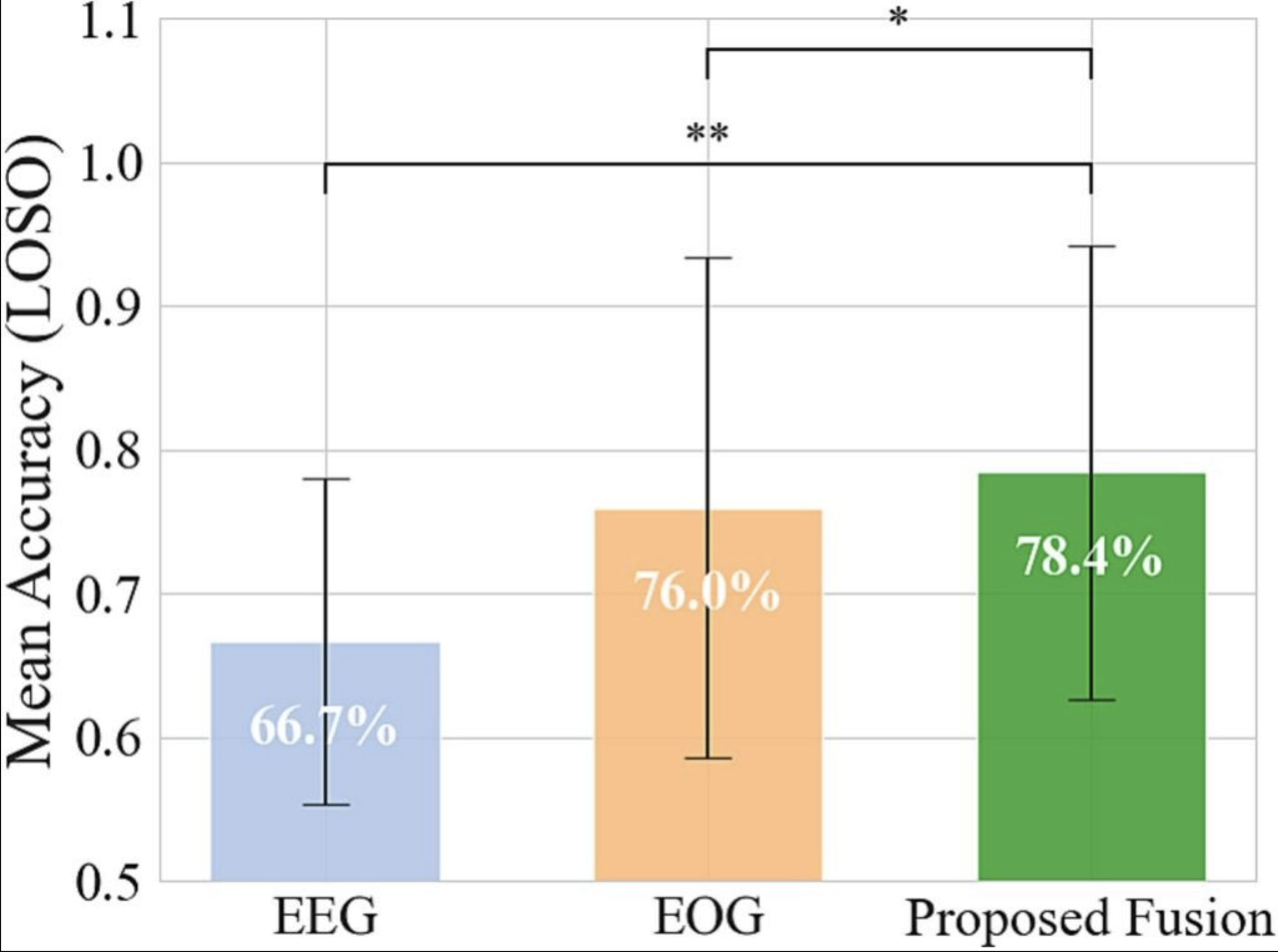
Researchers at Nanjing University of Aeronautics & Astronautics developed a fatigue detection system published in March 2026 that measures electrical activity from the brain and the eyes (electrooculogram, or EOG). Previous studies showed that tracking eye movement and blinks could provide additional information on fatigue levels, and that mixed-mode recording could be more reliable than singular systems6. The technology developed used a CNN model for the EEG data and a feedforward neural network for the EOG data. With an accuracy of 78.43%, the combined approach outperformed the chosen baseline, which used EEG solely, as seen in the graph below.
Comparing the accuracy of EEG, EOG, and an EEG-EOG combination for fatigue detection. Combining modes shows a higher accuracy than individual approaches6.
Can EEG-based wearables be enough to detect fatigue?
Across these methods, there is a lack of testing on real-world driving, which would include factors like vehicle movement or lighting changes6. Even factors like weather can have effects on driver concentration. More diverse participants, like those across age groups who are affected differently by sleep deprivation, need to be considered. Deep learning algorithms could be made more accurate by factoring these uncertainties into training data, as opposed to after data collection7. Additionally, biosensing setups should not be bulky or distracting, or they will not be adopted by users. Wearable systems using lightweight headsets or glasses could be most suitable for drivers. Furthermore, biological measurements could be combined with emotional assessment, such as self-reported stress levels, to provide a more holistic view.
In future, standardised fatigue detection systems in transport vehicles could improve safety for drivers, passengers and pedestrians. By designing wearable headsets that combine multiple sensing methods, signs of fatigue and exhaustion could be better represented. Reducing road collisions with preventative programmes lowers the burden on healthcare workers and improves wellbeing for disproportionately affected individuals, such as night shift workers9.
References
Brake. (2024). Driver fatigue. [online] Available at: https://www.brake.org.uk/get-involved/take-action/mybrake/knowledge-centre/driver-fatigue.
Smith, A.P. (2016). A UK survey of driving behaviour, fatigue, risk taking and road traffic accidents. BMJ Open, 6(8), p.e011461. doi: https://doi.org/10.1136/bmjopen-2016-011461.
Billones, R., Liwang, J.K., Butler, K., Graves, L. and Saligan, L.N. (2021). Dissecting the fatigue experience: A scoping review of fatigue definitions, dimensions, and measures in non-oncologic medical conditions. Brain, Behavior, & Immunity - Health, [online] 15(100266), p.100266. doi: https://doi.org/10.1016/j.bbih.2021.100266.
Chen, Z. and Li, X. (2026). An adaptive time–frequency attention-based CNN–LSTM for robust fatigue detection using EEG signals. Biomedical Signal Processing and Control, [online] 120, p.109996. doi: https://doi.org/10.1016/j.bspc.2026.109996.
St, E.K., Frey, L.C., Britton, J.W., Frey, L.C., Hopp, J.L., Pearce Korb, Koubeissi, M.Z., Lievens, W.E., Pestana-Knight, E.M. and St, E.K. (2016). Electroencephalography (EEG): An Introductory Text and Atlas of Normal and Abnormal Findings in Adults, Children, and Infants [Internet]. [online] Nih.gov. Available at: https://www.ncbi.nlm.nih.gov/books/NBK390346/.
Ding, M., Li, B., Fang, M., Wei, Z. and Zhang, M. (2026). A multilevel EEG-EOG fusion framework for driver fatigue detection using evidential reasoning. Biomedical Signal Processing and Control, 120, p.110176. doi: https://doi.org/10.1016/j.bspc.2026.110176.
Kakhi, K., Asgharnezhad, H., Khosravi, A., Alizadehsani, R. and Acharya, U.R. (2026). Fatigue Detection with Multimodal Physiological Signals via Uncertainty-Aware Deep Transfer Learning. Journal of Bionic Engineering, 23(1), pp.472–487. doi: https://doi.org/10.1007/s42235-025-00827-0.
Bergmann, D. (2025). What is deep learning? [online] ibm.com. Available at: https://www.ibm.com/think/topics/deep-learning#763338456.
NHS England (2020). Our approach to reducing healthcare inequalities. [online] www.england.nhs.uk. Available at: https://www.england.nhs.uk/about/equality/equality-hub/national-healthcare-inequalities-improvement-programme/our-approach-to-reducing-healthcare-inequalities/.