From Demotion to Nobel Prize: The Relentless Journey of Dr. Katalin Karikó
The journey of a female biologist turning doubts into the fuel of success, believe in herself and used her discovery to save the world
– 5 min read
The journey of a female biologist turning doubts into the fuel of success, believe in herself and used her discovery to save the world
By Edith Ko
Time flies, it has now been six years since the COVID-19 pandemic began. In those early days, the world was clueless against a virus we didn't understand - until a new generation of vaccines arrived in record time. Many wondered: how was it possible to develop a vaccine so quickly when historical precedents took a decade or more?
The answer lies in the pioneering work of Dr. Katalin Karikó and her colleague, Dr. Drew Weissman and their decades-long obsession with messenger RNA (mRNA) provided the blueprint for the world’s fastest medical response (The Nobel Prize, 2023b; Yu, 2021).
But this success was long coming. In the 1990s, the scientific community largely dismissed mRNA as unstable, dangerous, and useless for therapy (Hafner et al., 2025; Rogers, 2024). So, what drove Karikó to persist when her peers told her she was chasing a dead end? To understand more about COVID vaccine, we must learn about the relentless journey of Katalin Karikó first
Born on January 17, 1955, in the small rural Hungarian town of Kisújszállás, Dr. Katalin Karikó did not grow up with the advantages of wealth or a family background in science (Rogers, 2024). Yet, growing up surrounded by nature boosted her curiosity in biology. In her official Nobel Prize interview, she recalled, "I watched my father, who was a butcher, and I was interested in how the heart looks, how the lung looks... I was not afraid of the blood."(The Nobel Prize, 2023a)
This early exposure to anatomy fueled her academic drive Karikó to win several national biology competitions before entering the University of Szeged, a premier research hub in Hungary (Rogers, 2024). There, she completed her Bachelor’s degree and a PhD in biochemistry (1982), eventually beginning her initial work with mRNA at the Hungarian Academy of Sciences (Rogers, 2024). In 1985, after her lab lost its funding, she immigrated to the United States to continue her research at Temple University (Hafner et al., 2025). By 1989, she joined the University of Pennsylvania, where she dedicated herself to her primary mission: transforming mRNA into a viable medical therapy (Yu, 2021).
During her years at UPenn, she focused on how to use mRNA as a medicine. She noticed that dendritic cells recognize in vitro (the technique of conducting experiments or procedures in an artificial environment outside a living organism, such as in a laboratory setting) transcribed mRNA as a foreign substance, which leads to their activation and the release of inflammatory signaling molecules (Karikó & Weissman, as discussed in Nair, 2021). The inflammatory signal triggered is what stops mRNA to be a medicine means that's what we would avoid triggering. Based on this discovery, Karikó carried on further investigation and discovered that two natural and synthetic mRNA with the same sequence react differently when injecting to the immune system (Nair, 2021). This is because the immune system wasn’t reacting to the genetic code but to the chemical structure.
That means adding naturally occurring chemical modifications to mRNA bases prevents the strong inflammatory response normally triggered by unmodified, lab‑made mRNA (Nair, 2021). This leads to another gap of investigation, what kind of chemical modification can avoid inflammatory responses? In 1998, Kariko collaborated with Weissman and trials with different modification of nucleotides via their key,they discovered they could make synthetic mRNA look like natural mRNA by replacing uridine(U) with pseudouridine during the in vitro transcription process (Nair, 2021; Yu, 2021), making the synthetic mRNA to act like self cell to avoid triggering the immune system for therapy use and significantly increase the protein synthesis compared to unmodified mRNA.
In 2005, they published an invention but unfortunately, no one recognised it. Even Kariko mentioned in various interviews "We thought the phone would be ringing off the hook. But nothing happened. The phone didn't ring. Nobody cared." (Hafner et al., 2025)
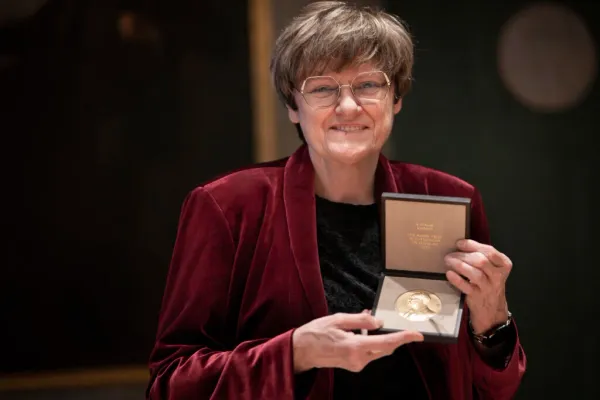
Their hard work has finally got recognised in 2020. The modified mRNA helps with avoid inflammation signal triggered before the vaccine could even start working, allow more stable and high volume of protein produced for a higher efficiency (The Nobel Prize, 2023b). In addition,researchers can just slot in the modified mRNA template form Kariko and Weissman to design a COVID vaccine with the given SAR-CoV-2 virus genetic sequence. This is the reason why it only takes a few days to finish designing a vaccine, largely decrease the time required for vaccine production (Yu, 2021; The Nobel Prize, 2023b). This huge success led her path to become a Nobel Prize winner in 2023 for physiology and medicine (The Nobel Prize, 2023a).
The whole journey might sound glamorous but there were many hardships within these years. Throughout her career, Dr. Katalin Karikó faced overwhelming institutional and scientific resistance, largely because the scientific community viewed mRNA as too unstable and inflammatory for medical use (Hafner et al., 2025; Rogers, 2024). At the University of Pennsylvania, she endured constant grant rejections, lacked her own lab and a university salary, and was even denied basic supplies like deionized water. In 1995, she was forced to choose between abandoning her research or accepting a demotion.She chose the demotion and its accompanying pay cut just to keep her experiments alive (Hafner et al., 2025). Even her scientific breakthroughs were initially met with failure, as her synthetic mRNA often made lab animals sick or caused them to die (Nair, 2021). Despite her landmark 2005 discovery, her work was dismissed by major journals as an "incremental contribution," and in 2013, the university’s refusal to reinstate her to a faculty position left her belongings piled in the hallway. This forced her to leave her academic life (Hafner et al., 2025).
Looking back to her path to become a Nobel Prize winner, resilience is the one thing that she cannot be without. The number of doubts and ignorance definitely shapes her success today. She had even publicly thanked people who doubted her "I also thank the people who tried to make my life miserable -because they made me work harder and become more resilient." (The Nobel Prize, 2023a). Leading on to that she has her own point of view on failure. She does not see it as a stop sign, but as a necessary data point instead, because you learn more for your failure (Nair, 2021). Despite talking about how to manage failure, she also talks about how to manage success. For Karikó, success isn't about the final award, but the ability to maintain enthusiasm through the "99 percent challenge" of science (The Nobel Prize, 2023a). So success does not need to be some sort or grand achievement, it can just be you stand up and keep on with the same enthusiasm as before. This mindset will drive you to what you desire.
Citations
Hafner, K., Unger, D., Saldivia, G. and The (2025). Katalin Karikó’s Nobel Prize–Winning Work on mRNA Was Long Ignored—And Led to COVID Vaccines. [online] Scientific American. Available at: https://www.scientificamerican.com/article/katalin-karikos-nobel-prize-winning-work-on-mrna-was-long-ignored-and-led-to/ [Accessed 23 Feb. 2026].
McKie, R. (2024). Breaking Through: My Life in Science by Katalin Karikó review – real-life lessons in chemistry. The Observer. [online] 11 Feb. Available at: https://www.theguardian.com/books/2024/feb/11/breaking-through-my-life-in-science-by-katalin-kariko-review-real-life-lessons-in-chemistry [Accessed 23 Feb. 2026].
Nair, P. (2021). QnAs with Katalin Karikó. Proceedings of the National Academy of Sciences, 118(51). doi:https://doi.org/10.1073/pnas.2119757118.
Rogers, K. (2024). Katalin Kariko | Biography, Facts, mRNA Vaccine, & COVID-19 Vaccine | Britannica. [online] www.britannica.com. Available at: https://www.britannica.com/biography/Katalin-Kariko [Accessed 23 Feb. 2026].
The Nobel Prize (2023a). The Nobel Prize in Physiology or Medicine 2023. [online] NobelPrize.org. Available at: https://www.nobelprize.org/prizes/medicine/2023/kariko/facts/ [Accessed 23 Feb. 2026].
The Nobel Prize (2023b). The Nobel Prize in Physiology or Medicine 2023. [online] NobelPrize.org. Available at: https://www.nobelprize.org/prizes/medicine/2023/press-release/ [Accessed 23 Feb. 2026].
Wikipedia Contributors (2021). Katalin Karikó. [online] Wikipedia. Available at: https://en.wikipedia.org/wiki/Katalin_Karik%C3%B3 [Accessed 23 Feb. 2026].
Yu, T. (2021). How Scientists Drew Weissman (MED’87, GRS’87) and Katalin Karikó Developed the Revolutionary mRNA Technology Inside COVID Vaccines. [online] Boston University. Available at: https://www.bu.edu/articles/2021/how-drew-weissman-and-katalin-kariko-developed-mrna-technology-inside-covid-vaccines/ [Accessed 23 Feb. 2026].